

Alerts show that cloud spend is approaching a threshold; a hard cap enforces one. A cloud budget circuit breaker combines both controls: set a soft limit to warn, then a hard limit to throttle, stop, or redirect requests when spending crosses the defined boundary. This makes the response operational, not just informational.
Alerts remain useful when teams need time to investigate or workloads must continue uninterrupted, but alerts alone do not contain costs. Match the control to the workload’s risk: block requests when budget protection takes priority, or preserve service through a degraded mode or lower-cost fallback when availability matters more.
This article explains how to implement the control logic, establish a spending baseline, and connect thresholds to automated actions. It also compares hard caps with alerts, including when to use each and how a monthly provider cap differs from a per-task fuse. The result is a practical framework for containing abnormal cloud and API spend without treating every threshold breach as the same event.
Key Takeaways
- Use a rolling spend baseline to distinguish normal variation from abnormal burn, then define the conditions that trip the control.
- Pair warning thresholds with an enforcement boundary: alerts provide time to respond, while hard caps block further spend.
- Choose the response for each workload’s risk profile, from throttling requests to degrading service or routing traffic to a lower-cost path.
- Combine a monthly provider cap with a per-task fuse to contain both account-level exposure and runaway individual jobs.
How can I implement a Circuit Breaker for this solution?
Define a spending baseline, set trip conditions, and map each threshold to an enforcement action. Apply separate limits to cloud accounts, API usage, and individual tasks.
Rolling Spend Windows and Trip Conditions
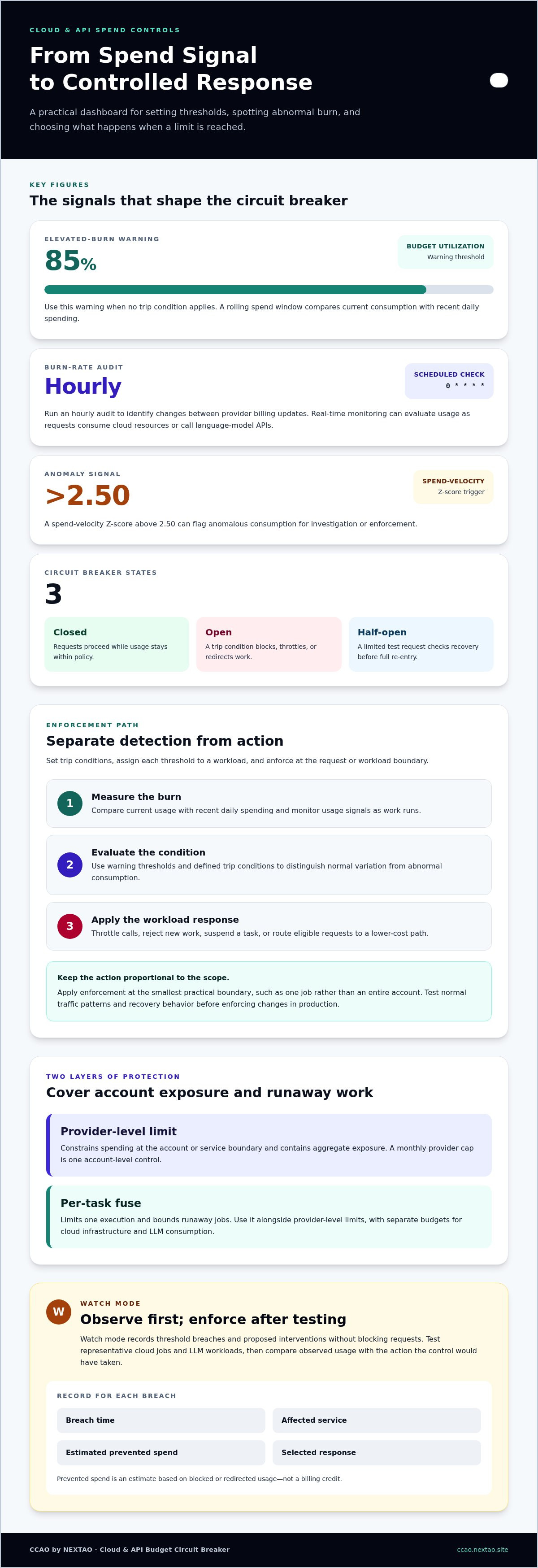
A rolling spend window compares current consumption with recent daily spending to distinguish normal variation from abnormal burn. Set an elevated-burn warning at 85.0% budget utilization when no trip condition applies. These thresholds give teams a defined protection boundary, rather than relying on a fixed monthly total alone.
Real-Time Spend Monitoring and Enforcement
Real-time monitoring evaluates usage signals as requests consume cloud resources or call language-model APIs. Use an hourly burn-rate audit, scheduled with the cron expression 0 * * * *, to identify changes between billing updates. A spend-velocity Z-score above 2.50 can flag anomalous consumption. Enforcement should occur at the request or workload boundary: throttle calls, reject new work, or route requests to a lower-cost path. This separates fast operational signals from provider billing totals, which may update on a different schedule.
Watch Mode and Prevented-Spend Reporting
Watch mode records threshold breaches and proposed interventions without blocking requests. Test it against representative cloud jobs and LLM workloads, then compare observed usage with the action the control would have taken. Report the breach time, affected service, estimated prevented spend, and selected response. Treat prevented spend as an estimate based on blocked or redirected usage, not as a billing credit. This evidence helps tune thresholds before enforcement changes production behavior.
Provider-Level Spending Limits
A provider-level limit constrains spending at the account or service boundary, while a per-task fuse limits one execution. Use both: the first contains aggregate exposure, and the second bounds runaway jobs. Apply separate budgets to cloud infrastructure and LLM consumption, then match each enforcement action to the workload’s tolerance for interruption.
Circuit breaker pattern for cloud costs
A cloud cost circuit breaker applies the software pattern to resource consumption, not electrical current. It moves through three states: closed, open, and half-open. In the closed state, requests proceed while usage stays within policy. A trip condition opens the circuit and blocks, throttles, or redirects work. After a defined recovery condition, the half-open state allows a limited test request. This provides controlled re-entry instead of an automatic full restart.
Separate detection from action. For example, a service can detect abnormal API request volume, open its circuit, and route eligible work to a lower-cost fallback. Define which workload owns each threshold and what action follows a breach. Test these transitions against normal traffic patterns before enforcing them. Each verified state change should produce a traceable event that records the trigger and action taken.
Electrical breaker installation and panel replacement are separate scopes. A cloud circuit breaker uses software controls; it does not replace a physical breaker or require an electrical panel upgrade. Electrical installation or replacement costs are therefore not cloud implementation costs. For cloud systems, assess the engineering work instead: telemetry connections, provider and API coverage, enforcement points, and test scenarios.
Reduce implementation effort by limiting the first release to one account, one API, and one defined response. Reuse existing spend telemetry when it provides the required signal. Test blocked requests, fallback routing, and recovery separately, then expand coverage after reviewing the results. This narrows the initial change while exposing gaps in thresholds or permissions. Avoid broad shutdown actions until their impact on workloads is understood.
For teams implementing request-level spend enforcement, cloud cost enforcement controls can provide a focused next step.
Hard budget caps versus alerts
Alerts report that spending crossed a threshold; hard limits enforce a boundary. A soft limit warns the operator, while a hard limit can block requests. Use alerts when someone needs time to review an unexpected billing pattern or approve continued operation. Use enforcement when further consumption must stop without waiting for a manual response.
For example, an alert can notify a team when a development workload approaches its assigned budget. The operator can inspect deployment activity, identify a test loop, and decide whether to pause it. This control is useful when legitimate workload variation matters and interruption carries an operational cost. It relies on someone receiving and acting on the notification before more usage accrues.
A hard cap suits workloads with a strict spending ceiling, especially isolated experiments or untrusted, user-triggered jobs. Define what happens at the boundary: reject new requests, suspend a task, or shift eligible work to a lower-cost route. A cap directly protects the budget, but it can interrupt valid processing. Apply the action at the smallest practical scope, such as one job rather than an entire account.
Combine both controls when teams need warning and enforcement. Place an alert before the hard boundary so the operator can investigate while requests remain available. Set enough space between the thresholds for a meaningful response, based on workload behavior and the time needed to act. Then test the hard limit with a controlled request and confirm that it blocks as expected. Review alert delivery and enforcement logs separately: a delivered warning does not prove the cap is working.
Neither control replaces the other. Alerts provide context and human discretion; hard caps provide automated containment. Choose based on whether continued operation is acceptable after the threshold and whether billing exposure outweighs the impact of stopping work.
What actions can a cloud cost circuit breaker trigger, such as stopping instances or disabling services?
A circuit breaker can fail closed, degrade service while failing open, or divert requests to a lower-cost fallback. The selected response determines what happens when a spending or usage condition trips. Match the action to the workload: stopping a nonessential compute instance differs from disabling a service that supports active transactions.
Use a graduated response when one action would be too broad. For example, first throttle a costly API route, then reject new requests if consumption keeps rising. A compute workload can stop launching additional instances while existing work completes. A service-level control can disable an optional feature while keeping its core dependency available.
- Throttle: Reduce request volume or concurrency for a specific API or workload.
- Stop: Halt a noncritical instance, scheduled job, or new task launch.
- Disable: Turn off an optional service or feature that drives unexpected consumption.
- Divert: Route eligible requests to a lower-cost fallback path.
Choose fail closed when continued requests could exceed a strict budget boundary. This blocks the affected operation until the circuit resets or an operator authorizes recovery. Choose degraded service when availability matters more than full functionality. For example, a language-model application can defer a nonessential generation path while preserving a reduced-response route. A fallback needs its own limits, or it could transfer the same cost exposure elsewhere.
Scope each action to the smallest affected service, and record the trigger, target, and result. Define a recovery condition before activation, such as an operator review or a stable usage signal. Test the stop, disable, and fallback paths in a controlled environment. Configure request-level enforcement and automated notifications with a cloud and API spend control.
CCAO by NEXTAO: Cloud & API Budget Circuit Breaker
CCAO by NEXTAO provides the Cloud & API Budget Circuit Breaker for scheduled cloud and API spend monitoring with hard-cap enforcement. It tracks spend, detects anomalies, prevents breaches, and sends team notifications. Use it when alerts alone leave a gap between detecting a threshold breach and containing further consumption.
The closed-source SaaS uses server-side AES-256-GCM encryption, PostgreSQL with Row-Level Security, and least-privilege credentials. Infrastructure checks run daily. These controls support isolated data handling while the budget circuit breaker applies defined spending boundaries. It is relevant when teams need scheduled visibility and automated enforcement across cloud or API spend, rather than managed hosting or incident response.
Review the Cloud & API Budget Circuit Breaker at ccao.nextao.site to assess its fit for your spend controls.
Make Cost Boundaries Part of Service Design
Treat spend protection as a production control, not a billing cleanup task. Assign an owner to each threshold, define who can authorize recovery, and document which workloads may be interrupted. These decisions connect budget policy to deployment and access processes, helping ensure a new service has an appropriate cost boundary before it runs.
A cloud budget circuit breaker works best when its trigger, action, and reset path remain explicit as systems change. Revisit these controls when teams add providers, APIs, or new workload patterns. CCAO by NEXTAO offers the Cloud & API Budget Circuit Breaker for scheduled spend monitoring and hard-cap enforcement.
To assess how it fits your control design, contact CCAO by NEXTAO. Establish the boundary before the next deployment expands your spend surface.
Frequently Asked Questions
What is a cloud budget circuit breaker?
A cloud budget circuit breaker detects spending or usage conditions and applies a predefined response. Unlike a dashboard, it can connect a threshold to an automated action. For example, an API service might reject additional requests after its allocated budget is exhausted. The policy should identify the monitored resource, trigger, permitted response, and condition for restoring normal access.
How can you automatically stop cloud spending when a budget threshold is reached?
Connect a spend signal to an enforcement mechanism with permission to affect the relevant resource. For example, a job controller can refuse new runs after its assigned limit trips while leaving unrelated workloads active. Scope credentials to the smallest required action, log each decision, and test the blocked path. A notification alone cannot stop consumption; the system needs an authorized control point that can reject or suspend work.
Which cloud providers support budget alerts and automated spending controls?
Provider capabilities differ, so confirm that each platform exposes usable spend data and an enforcement path for your workload. CCAO by NEXTAO supports integrations with GCP, AWS, and OpenAI for scheduled cloud and API spend monitoring and hard-cap enforcement. For a multi-provider design, map each account and API to its own signal, permission boundary, and response. Do not assume an alert feature can also block usage.
What are the costs and limits of cloud budget alerts and automated controls?
Costs and limits depend on the provider, metered services, account structure, and control mechanism. A budget threshold defines when the policy reacts, but does not necessarily limit the provider’s underlying billing meter. Set a boundary at the level you need to protect, such as a project, API, or job. For a SaaS control, review the subscription terms and enforcement scope before adopting it.
How do you set up a cloud budget circuit breaker step by step?
Start by naming the resource and identifying its spend signal. Define the threshold, then select an action the service can enforce, such as rejecting new job submissions. Grant only the permissions needed for that action. Next, test a simulated breach and confirm the logs capture the trigger and outcome. Finally, document who can authorize a reset and the recovery condition, so operators can restore access deliberately.
How quickly do cloud billing data and budget alerts update?
Update speed depends on when a provider publishes usage data and how often the alert evaluator processes it. Billing exports, usage APIs, and local telemetry can follow different schedules, so an alert may lag behind active consumption. For fast-moving workloads, pair billing data with request- or resource-level signals. Set the enforcement control to evaluate a signal it can receive consistently, and record the evaluation time for each event.
